James Webb detects 'forbidden' radiation of H₃⁺ ion for first time
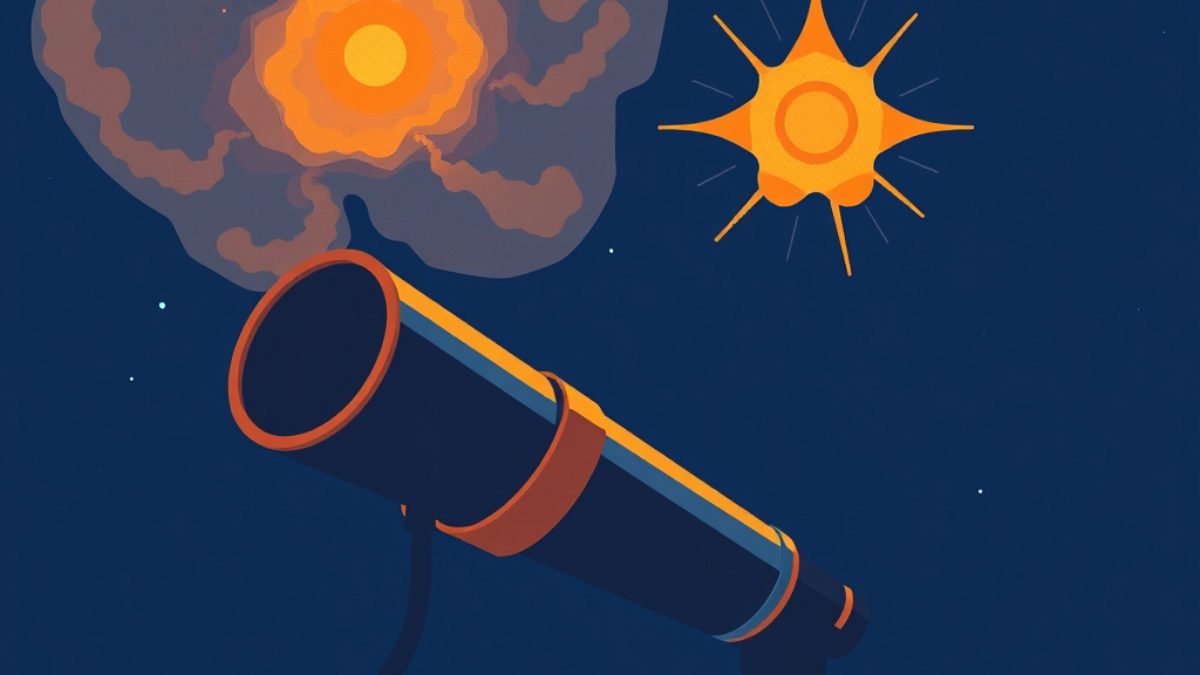
Astronomers led by David Neufeld of Johns Hopkins University have used the James Webb Space Telescope to detect rotational emission from the triatomic hydrogen cation H₃⁺. It was predicted in 1986, but until now had not been detected either in space or in the laboratory.
The signal was found in the spectra of the Herbig-Haro object HH 168 in the constellation Cepheus, approximately 700 parsecs from Earth. The observations were carried out using the MIRI spectrograph. Such objects occur when narrow jets of matter ejected by a young star crash into the surrounding gas, and shock waves heat it to thousands of degrees. The scientists identified 26 lines of H₃⁺ with a significance above 5 sigma. The brightest of them, at a wavelength of 16.325 μm, reached 72 sigma in one of the regions.
The three hydrogen nuclei in this ion form an equilateral triangle, so it lacks a permanent dipole moment, and standard selection rules do not allow it to radiate during pure rotation. In 1986, Fu-Shih Pan and Takeshi Oka from the University of Chicago calculated that centrifugal forces during rotation slightly distort the ion's shape. This gives rise to a weak dipole moment. Such transitions are extremely improbable, hence the name "forbidden."
In terms of spatial distribution and velocity, the emission matched that of hot molecular hydrogen heated by shock waves. Two shock wave models explain the result only partially. One reproduced the H₃⁺ intensity with an accuracy of up to roughly a factor of 1.5, but extended beyond the conditions for which its code was validated. The other underestimated the intensity by a factor of 5–6. Characteristic lines of the ion were also found in archival observations of another object, HH 211.
As iXBT.com writes, the H₃⁺ spectrum could turn into a new tool for studying the ionization of hot gas in star-forming regions. To achieve this, researchers still need data on high-energy collisions of the ion with hydrogen.
Sources
- Хабр: «Уэбб» обнаружил «запрещённый» сигнал, который раньше не наблюдали ни во Вселенной, ни даже в лаборатории media outlet
- Hi-Tech Mail: Такого не видели даже в лаборатории: телескоп «Джеймс Уэбб» поймал «запрещенный» сигнал из космоса media outlet
- iXBT.com: Телескоп «Джеймс Уэбб» впервые зарегистрировал запрещённое излучение важнейшего космического иона, которое астрофизики предсказали ещё в 1986 году, но не могли обнаружить media outlet
This article was prepared with the help of AI and translated from the Russian original. Spotted an error — let us know.
Published 14 November 2026, 21:01 · No updates · Russian original

Comments on this story live under its post in our Telegram channel. Comment on Telegram