Scientists from China Test Underwater Solar Panels in the Sea
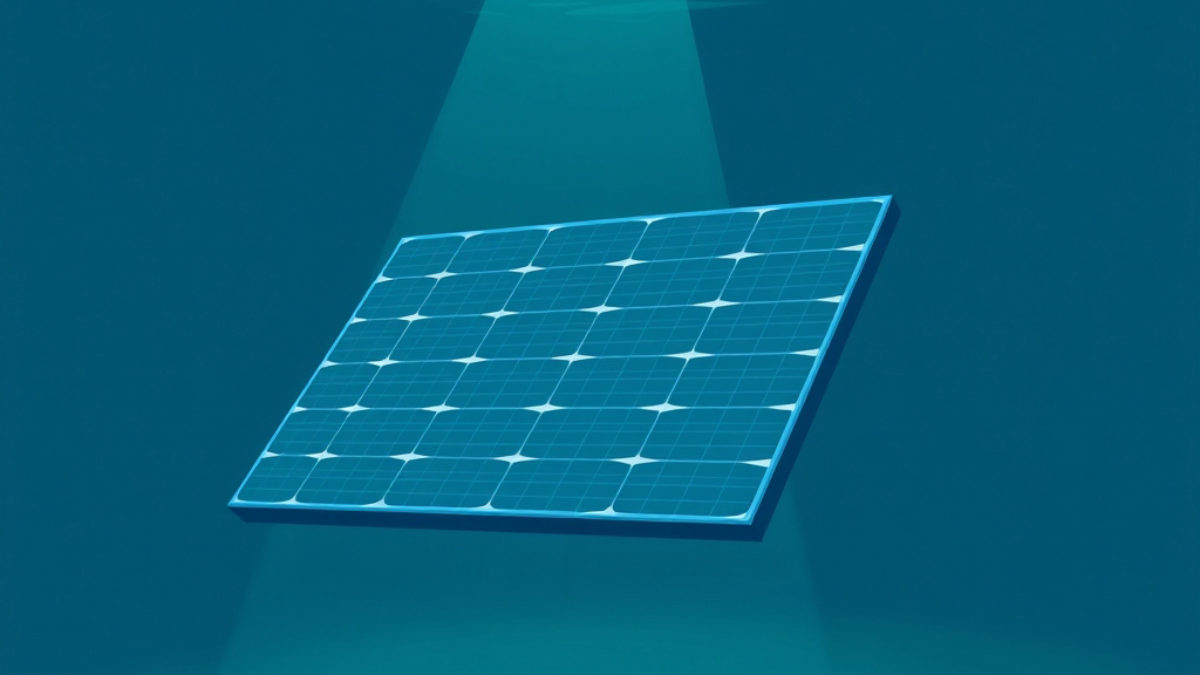
Researchers from Yunnan University have successfully tested perovskite solar modules at depths of up to 10 meters in the South China Sea.
Researchers from Yunnan University have successfully tested perovskite solar modules at depths of up to 10 meters in the South China Sea. The results of the scientific work were published in the journal Joule.
The development is designed to solve the problem of powering underwater sensors, cameras, and communication devices. Ordinary silicon panels are inefficient underwater, as the water absorbs red light. Specialists have created wide-band lead-halide elements designed for the blue-green spectrum, which penetrates to a depth.
In laboratory tests under illumination simulating a depth of 10 meters, a small photovoltaic cell showed an energy conversion efficiency of 34.71%, and a module with an area of 28.79 square centimeters showed about 29.4%. To protect against seawater, the structure was covered with a multilayer shell made of butyl rubber, epoxy resin, and protective glass, and the stability of the crystal structure was increased using a chemical additive PHMG.
During the tests near Weizhou Island in the South China Sea, the modules charged batteries for 1416 mW·h at a depth of 2 meters, 752 mW·h at 6 meters, and 324 mW·h at 10 meters over a two-hour immersion period. The accumulated energy was enough to power a connected LED panel.
What it means
The technology allows for autonomous powering of underwater research equipment and environmental monitoring sensors without the need for regular battery replacement or laying of power cables.
Sources
- Hi-Tech Mail: Китай испытал солнечную электростанцию на глубине 10 метров в открытом море media outlet
- Хабр: Китайские учёные испытали подводные солнечные панели media outlet
- iXBT.com: Китайские ученые создали уникальный солнечный элемент — он вырабатывает электричество под водой с КПД до 34,71% media outlet
This article was prepared with the help of AI and translated from the Russian original. Spotted an error — let us know.
Published 22 September 2026, 10:31 · No updates · Russian original